publications
publications by categories in reversed chronological order. generated by jekyll-scholar.
2025
- ICMLCapturing Temporal Dynamics in Large-Scale Canopy Tree Height EstimationJan Pauls, Max Zimmer, Berkant Turan, and 4 more authorsIn ICML25: Proceedings of the 42nd International Conference on Machine Learning, 2025
With the rise in global greenhouse gas emissions, accurate large-scale tree canopy height maps are essential for understanding forest structure, estimating above-ground biomass, and monitoring ecological disruptions. To this end, we present a novel approach to generate large-scale, high-resolution canopy height maps over time. Our model accurately predicts canopy height over multiple years given Sentinel-1 composite and Sentinel 2 time series satellite data. Using GEDI LiDAR data as the ground truth for training the model, we present the first 10m resolution temporal canopy height map of the European continent for the period 2019-2022. As part of this product, we also offer a detailed canopy height map for 2020, providing more precise estimates than previous studies. Our pipeline and the resulting temporal height map are publicly available, enabling comprehensive large-scale monitoring of forests and, hence, facilitating future research and ecological analyses.
@inproceedings{pauls2025capturing, url = {https://arxiv.org/abs/2501.19328}, title = {Capturing Temporal Dynamics in Large-Scale Canopy Tree Height Estimation}, author = {Pauls, Jan and Zimmer, Max and Turan, Berkant and Saatchi, Sassan and Ciais, Philippe and Pokutta, Sebastian and Gieseke, Fabian}, booktitle = {ICML25: Proceedings of the 42nd International Conference on Machine Learning}, year = {2025}, earthengine = {https://europetreemap.projects.earthengine.app/view/europeheight}, } - RMSE
 Retrieving yearly forest growth from satellite data: A deep learning based approachMartin Schwartz, Philippe Ciais, Ewan Sean, and 9 more authorsRemote Sensing of Environment, 2025
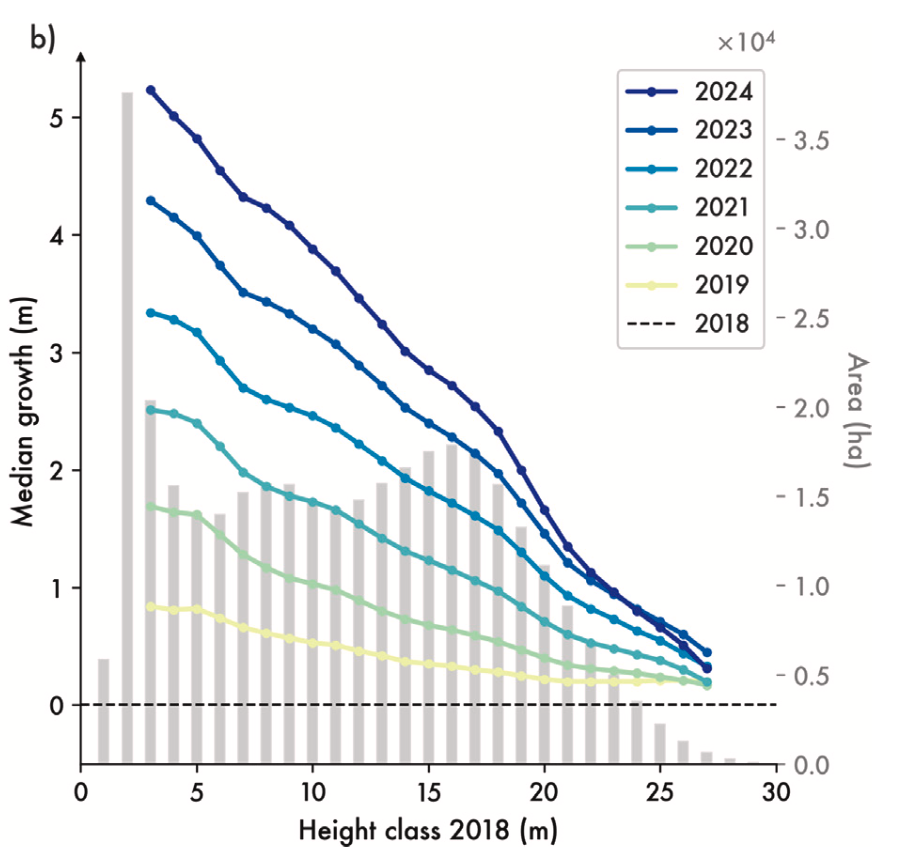
High-resolution mapping of forest attributes is crucial for ecosystem monitoring and carbon budget assessments. Recent advancements have leveraged satellite imagery and deep learning algorithms to generate high-resolution forest height maps. While these maps provide valuable snapshots of forest conditions, they lack the temporal resolution to estimate forest-related carbon fluxes or track annual changes. Few studies have produced annual forest height, volume, or biomass change maps validated at the forest stand level. To address this limitation, we developed a deep learning framework, coupling data from Sentinel-1 (S1), Sentinel-2 (S2) and from the Global Ecosystem Dynamics Investigation (GEDI) mission, to generate a time series of forest height, growing stock volume, and aboveground biomass at 10 to 30-m spatial resolution that we refer to as FORMS-T (FORest Multiple Satellite Time series). Unlike previous studies, we train our model on individual S2 scenes, rather than on growing season composites, to account for acquisition variability and improve generalization across years. We produced these maps for France over seven years (2018–2024) for height at 10 m resolution and further converted them to 30 m maps of growing stock volume and aboveground biomass using leaf type-specific allometric equations. Evaluation against the French National Forest Inventory (NFI) showed an average mean absolute error of 3.07 m for height (r2 = 0.68) across all years, 86 m3 ha-1 for volume and 65.1 Mg ha-1 for biomass. We further evaluated FORMS-T capacity to capture growth on a site where two successive airborne laser scanning (ALS) campaigns were available, showing a good agreement with ALS data when aggregating at coarser spatial resolution (r2 = 0.60, MAE = 0.27 m for the 2020–2022 growth of trees between 10 and 15 m in 5 km pixels). Additionally, we compared our results to the NFI-based wood volume production at regional level and obtained a good agreement with a MAE of 1.45 m3 ha-1 yr-1 and r2 of 0.59. We then leveraged our height change maps to derive species-specific growth curves and compared them to ground-based measurements, highlighting distinct growth dynamics and regional variations in forest management practices. Further development of such maps could contribute to the assessment of forest-related carbon stocks and fluxes, contributing to the formulation of a comprehensive carbon budget at the country scale, and supporting global efforts to mitigate climate change.
@article{schwartz2025retrieving, url = {https://www.sciencedirect.com/science/article/pii/S0034425725003633}, title = {Retrieving yearly forest growth from satellite data: A deep learning based approach}, author = {Schwartz, Martin and Ciais, Philippe and Sean, Ewan and De Truchis, Aur{\'e}lien and Vega, C{\'e}dric and Besic, Nikola and Fayad, Ibrahim and Wigneron, Jean-Pierre and Brood, Sarah and Pelissier-Tanon, Agn{\`e}s and Pauls, Jan and others}, journal = {Remote Sensing of Environment}, volume = {330}, publisher = {Elsevier}, pages = {114959}, year = {2025}, } - SSRN
 Integrating Global Canopy Height Models with Satellite Data for Improved Forest Inventory in UkrainePetr Lukeš, Viktor Myroniuk, Andrii Shamrai, and 3 more authorsAvailable at SSRN 5495040, 2025
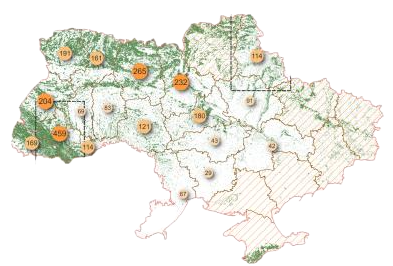
Accurate forest monitoring in Ukraine faces unprecedented challenges due to ongoing Russian aggression and limited access to traditional inventory methods, requiring robust satellite-based alternatives for National Forest Inventory operations. This study develops a comprehensive framework integrating state-of-the-art canopy height models with harmonized multi-sensor satellite data to achieve airborne LiDAR-comparable accuracy in forest structural parameter estimation. We evaluated six CHMs against 2,634 in-situ canopy height measurements across Ukraine. The most recent European-scale CHM by Pauls et al.(2025) demonstrated superior performance with R2= 0.68 and RMSE= 4.65 m. Using this CHM as input alongside harmonized optical (Sentinel-2) and radar (Sentinel-1, ALOS PALSAR) observations, we developed a machine learning framework testing 20 algorithms to address whether satellite-derived canopy height enhances forest structural parameter estimation and whether country-trained models match regionally specific approaches. Feature importance analysis revealed CHM-derived height as the dominant predictor (45-60%), followed by Sentinel-2 shortwave infrared bands and vegetation indices. This approach achieved relative RMSE values of 8.8-12.3% across four forest structural parameters: growing stock volume (R2= 0.77), basal area (R2= 0.68), stand age (R2= 0.53), and diameter at breast height (R2= 0.48). Performance improvements of 49-144% were observed compared to models without height information, matching operational airborne LiDAR accuracy in Finland and USA. The framework successfully generates wall-to-wall forest inventory maps with robust transferability across diverse forest conditions. This research establishes satellite-based forest inventory as a viable alternative for conflict-affected regions and data-scarce environments worldwide.
@article{lukevs5495040integrating,
  url = {https://papers.ssrn.com/sol3/papers.cfm?abstract_id=5495040},
  title = {Integrating Global Canopy Height Models with Satellite Data for Improved Forest Inventory in Ukraine},
  author = {Luke{\v{s}}, Petr and Myroniuk, Viktor and Shamrai, Andrii and Melnichenko, Viktor and Schwartz, Martin and Pauls, Jan},
  journal = {Available at SSRN 5495040},
  year = {2025},
}

2024
- ICML
 Estimating Canopy Height at ScaleJan Pauls, Max Zimmer, Una M Kelly, and 6 more authorsIn ICML24: Proceedings of the 41st International Conference on Machine Learning, 2024
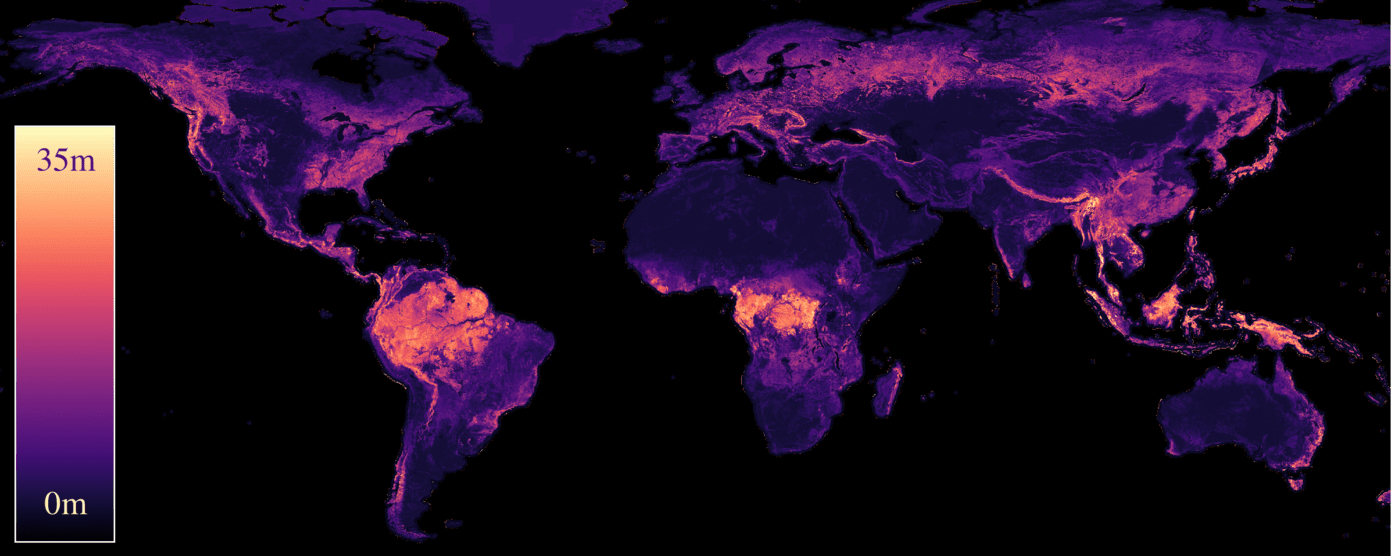
We propose a framework for global-scale canopy height estimation based on satellite data. Our model leverages advanced data preprocessing techniques, resorts to a novel loss function designed to counter geolocation inaccuracies inherent in the ground-truth height measurements, and employs data from the Shuttle Radar Topography Mission to effectively filter out erroneous labels in mountainous regions, enhancing the reliability of our predictions in those areas. A comparison between predictions and ground-truth labels yields an MAE / RMSE of 2.43 / 4.73 (meters) overall and 4.45 / 6.72 (meters) for trees taller than five meters, which depicts a substantial improvement compared to existing global-scale maps. The resulting height map as well as the underlying framework will facilitate and enhance ecological analyses at a global scale, including, but not limited to, large-scale forest and biomass monitoring.
@inproceedings{pauls2024estimating,
  url = {https://arxiv.org/abs/2406.01076},
  title = {Estimating Canopy Height at Scale},
  author = {Pauls, Jan and Zimmer, Max and Kelly, Una M and Schwartz, Martin and Saatchi, Sassan and Ciais, Philippe and Pokutta, Sebastian and Brandt, Martin and Gieseke, Fabian},
  booktitle = {ICML24: Proceedings of the 41st International Conference on Machine Learning},
  year = {2024},
  earthengine = {https://worldwidemap.projects.earthengine.app/view/canopy-height-2020},
}